The Clinic Efficiency Podcast
AI in Radiation Oncology: Matching Providers, Patients & Capacity
Featuring Corey Zankowski · · 21 min
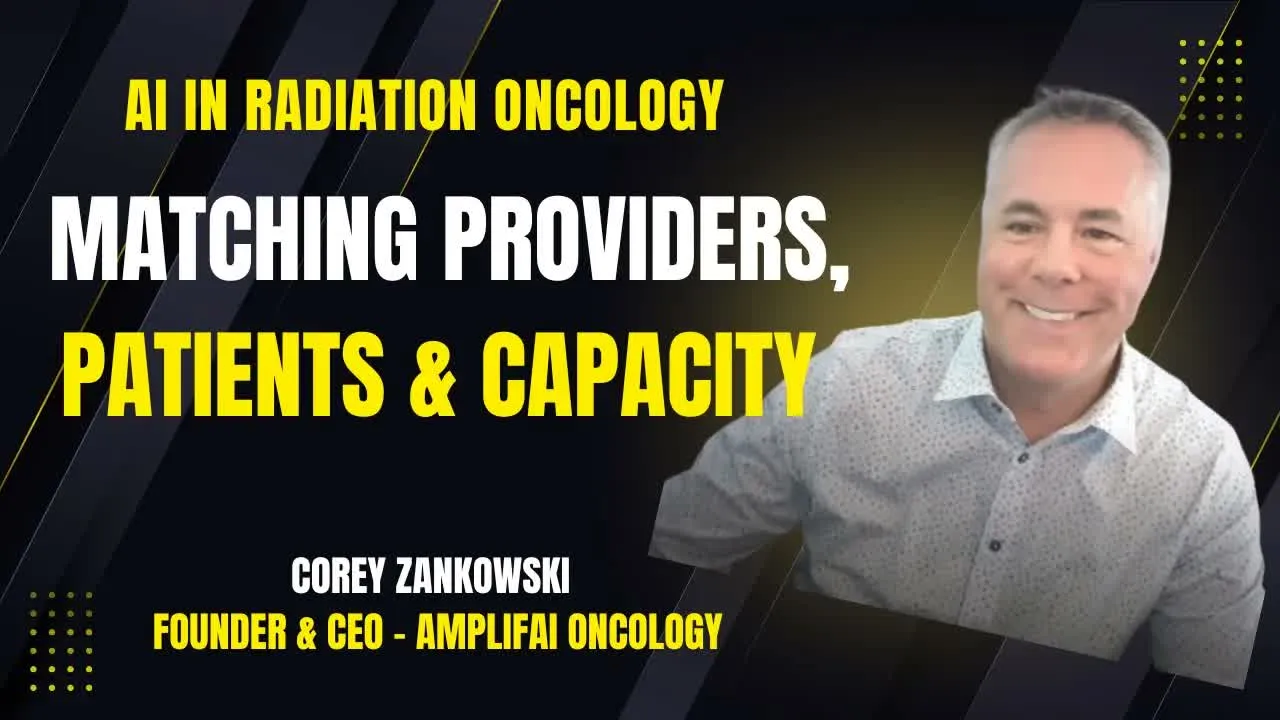 Watch on YouTube (21 min)
AmplifAI founder Corey Zankowski on how AI triage and case routing help community radiation oncology clinics handle uneven patient volumes without burning out their staff.
In this episode
- Why some community clinics are overwhelmed while others sit idle, and how routing cases between them helps both.
- How a complexity score triages cases so peer review spends its time where it matters.
- When a busy clinic should route overflow work instead of hiring, or asking staff for more overtime.
- Accelerate, augment, amplify: the three stages of putting AI to work in a clinic.
Transcript
Lightly edited for readability from the episode's captions.
Donald: Welcome, everyone. I’m really excited for today’s conversation. Today we’re joined by Corey Zankowski, the founder of AmplifAI Oncology. Corey, your career journey, particularly your focus on oncology and now leading AmplifAI, shows a deep understanding of the unique challenges faced by community cancer clinics. It’s clear you’re passionate about using AI to create more balanced and efficient care. Tell us a little about yourself.
Corey: First, Donald, thank you very much for having me on the program. I really appreciate the opportunity to speak with you.
I’m what’s called a medical physicist by training. I’ve got a background in physics, and the application of a medical physics degree is in the radiation oncology space. I’ve always been involved in radiation oncology. I worked a few years in a clinic before joining the largest radiation oncology vendor in the space, Varian Medical Systems, which is now part of Siemens Healthineers. I spent 22-plus years at Varian in various positions, and towards the end of my time there I was a C-suite executive, focused on technology and innovation for Varian. That involved exploring new technologies like AI, bringing them into our portfolio, and building tools our customers could use.
We were really focused on expanding global access to care. We were trying to see how new technologies could help bring very sophisticated, expensive devices into care in parts of the world that don’t enjoy the same level of resources we have here in the US, and don’t have the same skill sets. So a lot of my energy for a decade was focused on improving access to care by streamlining efficiency, improving the user experience and reducing cost.
Donald: Corey, the AmplifAI Oncology solution addresses a critical problem: the capacity imbalance in community radiation oncology clinics, where fluctuating patient loads make scaling with expensive equipment unfeasible. When did the vision for a capacity marketplace really take hold for you? What was the moment that led you to build AmplifAI Oncology?
Corey: It’s always a little more complex than you’d imagine. But suffice it to say that at a very large company like Varian, we were focused on supporting the hub-and-spoke model. Expertise is concentrated at the hub, and the community practices, the spokes, treat the routine cases and are expected to refer complex patients to the hub. That’s a lot of how we thought about the care paradigm when I was at Varian.
Unfortunately, my mother was diagnosed with cancer. I personally knew many radiation oncologists and oncologists around the world, particularly in the US, and I offered to introduce my mom to any one of them. She could have gone and got her treatment basically anywhere, and she refused. She insisted on being treated at home, in her community, close to her friends, her church and her support.
Then I realized we have to look at this problem in a different way. It’s not just about efficiently concentrating resources in certain areas. It’s really about getting the expertise into the communities when it’s needed, so people like my mother, who for whatever reason can’t travel or choose not to, can have access to that expertise. That’s when I really started to change my focus, and that was basically the genesis of AmplifAI.
How do we address this resource imbalance? When one location, staffed just by generalists, encounters that rare case, what do they do? How do they get access to the right expertise for their particular patient? That’s a lot of how we started. Then we realized it goes even broader than that: bringing in tools like AI that can look at the complexity of a case and make recommendations. You can generate the treatment plan for this one on your own, that’s fine. Or, for the more complex cases, suggesting that this may be one where you’d want to get some help.
So, Donald, we built matching algorithms to help people determine not only which cases to seek help with, but also to find the best person in our network for that particular case. You’re not just sending it away. You’re sending it to the best available person to work on the case.
Donald: That’s amazing. You can tailor it specifically to each patient and who really needs to treat them.
Corey: That’s right. And in doing this, one of the other things you notice, especially if you just look at the US, is that some community-based practices are bursting at the seams. There are too many patients for them to manage, and it’s very stressful in some of these clinics. That’s good for business, I guess, but it’s very challenging for the clinicians to handle all those cases.
In other situations, you have more strategically located practices that are there to serve the community, but the community isn’t large enough to support the workload. So some clinics are fairly idle, with excess capacity, and some are completely overwhelmed. That was another thing we discovered. How do we match these imbalances, so the people who are sitting idle can help out, even on routine cases, and take some patients off the busy clinic? They can monetize their resources too: if they have idle time, they can bring in a little extra revenue. And the overwhelmed clinic gets the help it needs in a cost-effective way, and still gets to treat its patients locally, which is good for them.
Donald: That’s pretty much my next question. On the AmplifAI Oncology website, you talk about connecting clinics to balance capacity. Can you explain how it works, and how it helps clinics, especially community-based departments, keep their high-value linear accelerators operating at peak efficiency?
Corey: The first thing you do is register with the platform. We check your NPI, your National Provider Identifier, to make sure everybody on the platform is certified as a radiation oncologist, a medical physicist or a medical dosimetrist. So we curate the community a little. Once you sign up, there are a few terms and conditions to agree to, you enter some payment information, and you’re basically ready to go.
When you have a case, you enter the case details. We can import PDFs, or you can type them in manually. I think most clinicians prefer to import data from their existing record systems. We analyze the case: the details about the patient and what the clinician is requesting. Is it a treatment plan? Is it a review? Then our algorithms go to work. When you submit the case, we automatically search our network for matches and show you a gallery of specialists for that particular case. You choose who you want to send it to, and if they accept, they can start working on it.
So it’s pretty straightforward. We have a large group of professionals who are willing to provide support for anybody, and we typically expect a turnaround of under 48 hours on a complex treatment plan. Sometimes that takes a week in your own clinic.
Donald: That’s great. Your AI strategy is fascinating: focusing on triage and recommendations rather than direct clinical decision-making, to avoid heavy regulatory overhead. Could you explain the two main AI functions, case triage and provider matching, and how they support clinicians without replacing their judgment?
Corey: Absolutely. Let’s start with triage, because triage really started as a way to support peer review. A lot of clinics do peer review as part of their routine practice. The challenge is that you might get 30 cases to look at in 60 minutes. That’s only two minutes per case, and going into the meeting, nobody knows which cases are the most complex or most interesting, and which are routine.
So what happens in a lot of these peer review meetings is they spend a lot of time going, “Yes, that’s a good patient, next. Yes, the treatment is fine on this one, next.” They run out of time, and by Murphy’s law the most challenging case comes up at the end, when there are five minutes left in the meeting and not enough time for proper discussion and learning.
What we can do is look at a case across the 50 or 60 parameters we examine and create a complexity score. Based on that score, we know whether a case should be reviewed by your top specialists because it’s unusual or there’s something interesting about it, or whether it’s fairly routine and a resident or junior faculty member could review it offline.
So we stratify the cases and bring only the most interesting or challenging ones, with the most educational content, to your chart rounds meeting. Those cases get discussed carefully and thoughtfully in a group setting. The ones reviewed offline are seen by fewer people, but each reviewer can spend more time on each case. Instead of 20 people looking at a case for two minutes each, one person can look at it for 10 or 15 minutes. You still save money, and you get a better-quality peer review as well. So it’s a win-win-win.
Donald: That makes sense. The problem of fluctuating patient volumes, leading either to unprofitable operations or overwhelmed staff, is a significant one. What’s been most effective in getting community oncology clinics to understand and embrace AmplifAI as a way to achieve operational efficiency?
Corey: I think it’s a problem of discovery. When we speak to a clinic, we don’t know in advance what its situation is. So part of it is understanding: are you on the excess-capacity side, the overwhelmed side, or somewhere in the middle?
Let me start with the middle, because it’s a little neglected. I think most clinics are operating evenly and are really well managed. But in a community setting, you can’t control the rate at which your community develops cancer and comes to see you, so you’re going to see natural fluctuations in patient demand. Practices that have been running for a long time reach a comfortable equilibrium. Then, as the community grows, or other things change, you see spikes. Typically, you ask staff to do a little overtime, which is more expensive, time and a half and so on, and going through those spikes leads to staff burnout.
We’re looking for clinics that have reached an inflection point, where it’s no longer once a month. It’s happening more and more often that they’re seeing more patients than before, and they have a decision to make. Do I hire full-time staff now to cover this excess patient load, or do we have our staff work a little longer?
When you’re at that inflection point, a solution like AmplifAI is a great interim solution, and perhaps a great long-term one too. We can pick up that excess patient load very quickly and turn it around. You can still treat all those patients on your linear accelerator, and during the period before it makes sense to add someone full-time to your team, you can use the expertise of our network to manage that extra workload.
Donald: That’s great. It really helps them with their decision-making about what they need to do.
Corey: Right. In our own decision-making, we’re trying to stay away from clinical decision-making, because we don’t want the extra regulatory overhead. Our algorithms that look at the complexity of cases can be used for a variety of things, but they guide clinicians in deciding which patients they’ll plan themselves and which they might send to someone else.
Donald: As a pre-revenue startup launching a pilot program soon, what signals or metrics are you focused on to drive clarity across the organization and make sure AmplifAI Oncology is moving in the right direction, especially as you look to scale?
Corey: That’s a great question. At this point we’re most interested in traction. We want people to use the platform, so of course we’re counting each use. But we really want to make sure the experience is very good on both sides: for the people providing services remotely, and for the people using those services.
So we’re tracking a two-way user rating, where each clinician can rate the interaction with the other and the quality of the work coming from the other. We’re tracking turnaround time and overall experience on the platform: how many cases you’ve done, of which complexity, which types, for which equipment manufacturers. It’s complex on the back end, but we’re monitoring all of it.
We’re also counting iterations. If I ask you to do something for me, and you do it, and I evaluate it and say, “That’s good, but I’d like a couple of changes,” that’s totally normal in radiotherapy treatment planning. We count the number of iterations and try to keep it as low as possible. We want as much information as possible communicated up front. We make it easy for the client side to express their request, and we try to capture that information fully so the remote provider can apply it when creating the treatment plan or doing the peer review.
Those are the things we’re looking at right now. The assumption is that if we do that well, scaling will be a great problem to have in a few months.
Donald: Looking further ahead, beyond capacity balancing, what other areas of oncology do you think are ripe for change, where AI can significantly improve clinic efficiency and patient outcomes?
Corey: I’m narrowly focused on radiation oncology problems, but one area where AI is perhaps already changing things is image processing. That applies to radiology, for detecting and diagnosing cancer, as well as to pathology. In radiation oncology, we’ve had AI segmentation, or auto-segmentation, available for almost a decade. A radiation oncologist needs to outline the tumor volumes as well as all the organs at risk, where you’re trying to avoid overdosing healthy tissue. We call it contouring, and it’s a lot of drawing. Sometimes that’s fairly quick, around 25 minutes. Sometimes it’s very involved, like a head and neck case with lots of tissues to identify, and it can take several hours.
In our field, we’re also looking at how to use AI to automate the treatment planning process, because treatment planning is extremely knowledge-intensive and relies on well-trained experts with specialized degrees. What the field is seeing is that we can train models on the final work of these highly skilled people, and start to predict what a good plan should be, given this patient’s anatomy and the prescription from the oncologist. There’s been a lot of work there that will take many hours and many rounds of trial and error out of the process.
We’re actively pursuing those kinds of tools to build into our platform. When a case is submitted, we’d interpret its complexity, run it through a risk-adjusted process, segment the images, generate the plan, run some quality assurance checks on it, and then provide it to the physician for final review. There are huge opportunities for workflow efficiency with AI in just that one narrow pipeline.
And with the arrival of large language models, which can reach into an archive of knowledge, find things in notes and summarize them for people, I think there’s a great opportunity for a new form of clinical decision support. Several companies are already working on this. It will help clinicians make decisions faster.
Donald: Absolutely.
Corey: And research the case. Many times you see a complex case and you don’t just want to trust the AI. You want it to cite its sources so you can go and read the papers and make sure this is something you truly want to do for your patient.
Donald: Corey, this has been very insightful, and I appreciate this discussion. I know our listeners will really value everything you’ve brought out today. Is there anything else you’d like to add?
Corey: Thank you, Donald, for the opportunity. There’s something I’ve often thought about, and now I’m reading about it in the context of software development. At Varian, we talked about different ways to apply AI to workflows. The first is to accelerate: make existing workflows faster. The next is to augment people, bringing knowledge to them and making knowledge accessible that they otherwise might not have had, so they can do a better job at whatever task they’re working on.
And the final stage of AI adoption, hence the name of our company, is amplification. You use AI to amplify what you’re capable of doing. Here’s an example of what we mean. If you take a workflow that used to take 20 minutes and compress it to two minutes, you’ve accelerated it. That’s great. If you can take those two minutes and compress them to 20 milliseconds, it’s essentially instantaneous. You could stop there and say you’ve fully accelerated the workflow. Or you could say that now lets you amplify your practice. You can explore a hundred or a thousand different treatment plan strategies, each taking 20 milliseconds. Instead of feeling that you got a very good result from your 20-millisecond process, you can be confident you’ve got the best result, because you’ve tried a thousand different things and chosen the optimal one. That’s what we call amplification. It lets you do things that otherwise wouldn’t be possible.
Donald: That’s amazing. It’s going to improve medical care tremendously. Thank you very much for your time today, Corey. We’d love to explore what’s happening with you again in the future.
Corey: I’d appreciate that opportunity, Donald. It was wonderful being part of your podcast.