The Bridge Podcast
Your Zip Code Shouldn't Decide Your Cancer Care
Featuring Corey Zankowski · · 26 min
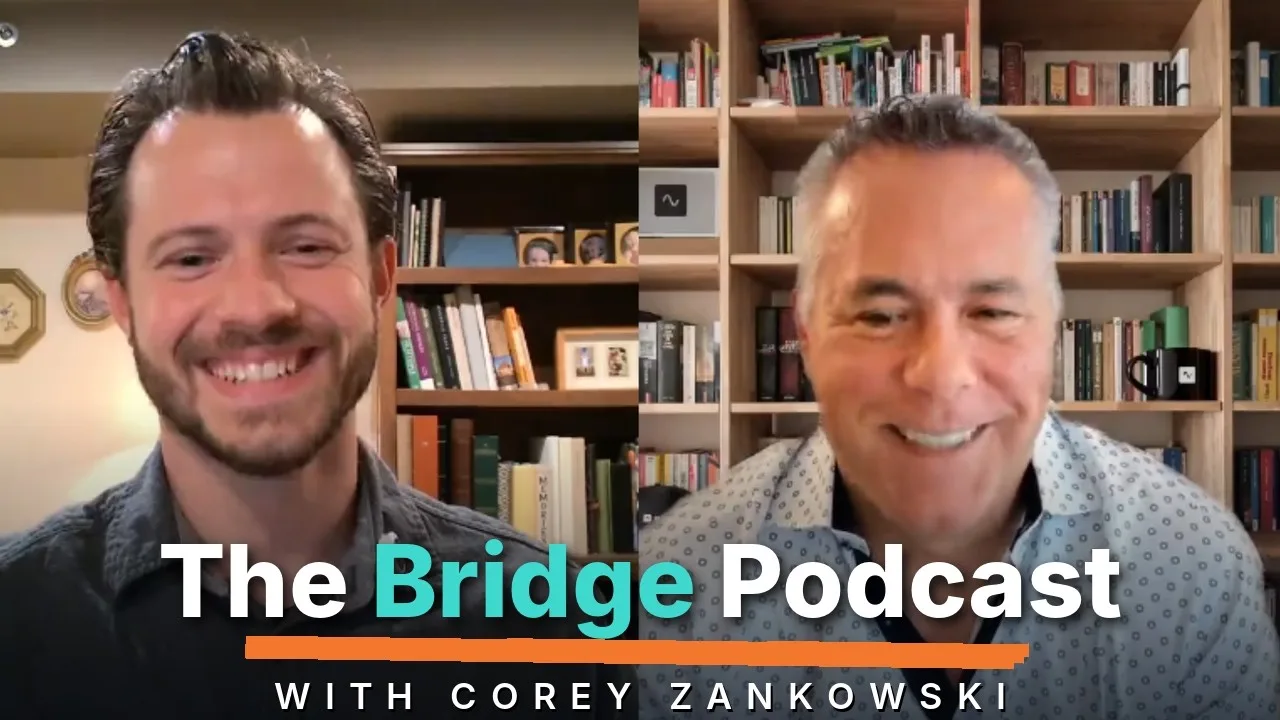 Watch on YouTube (26 min)
AmplifAI founder Corey Zankowski on why your zip code shouldn't decide your cancer care, and how a connected network moves expertise to patients instead of moving patients to expertise.
In this episode
- Why sending patients to distant cancer centers fails the many who can't, or won't, travel.
- How shorter radiotherapy schedules moved the bottleneck from the treatment machine to treatment planning.
- What a planning backlog looks like inside a clinic, and how routing cases to outside specialists clears it.
- Where AI fits in treatment planning, and what AmplifAI is building next.
Transcript
Lightly edited for readability from the episode's captions.
John: Welcome to The Bridge Podcast, for people done surviving the healthcare system and ready to shape it. This show connects the people delivering care on the ground with the people building the systems around them, because those two worlds don’t talk enough. Today’s guest spent decades on the technology side of cancer care, building the software that clinics use to plan radiation treatments. After those years of building the tools, he came to a surprising conclusion: the tools were never the real problem. Now, with AmplifAI Oncology, he connects cancer clinics with planning experts on demand. When a clinic is short-staffed or backed up, patients aren’t left waiting. Corey, welcome to the show.
Corey: John, thank you very much for having me. I’m really honored to be here.
John: Big picture, let’s start. What does AmplifAI Oncology do, and who do you do it for?
Corey: We’ve built a platform that, as you said, connects clinics that need some assistance with treatment planning, either because of a capacity challenge or an expertise challenge. The right expert for each patient doesn’t reside within every single clinic. So we built a platform that connects these clinics with other clinics and other clinicians who have the time, the expertise and the capacity to help them out. For clinics operating at or near capacity, having an overflow support option on demand is very valuable.
So that’s what we’ve built. Our platform has AI-based algorithms that look at the properties of each case and search our network to find the most appropriate treatment planner for that particular case. We try to do intelligent routing to the right expert, so you get a higher-quality treatment plan at the end of the day, and they’ll be able to do it in less time than somebody who didn’t have the same skills or experience.
John: So are the experts part of their own clinic, or do you have your own staff?
Corey: We don’t have our own staff. We’re partnering with companies that staff up on treatment planners, so dosimetrists and medical physicists who can do these treatment plans, and we’re leveraging them. There are also a few dosimetrists and physicists out there who have a day job and occasionally help out after hours, over weekends, that kind of thing. So it’s a mixture of both. In the United States, we’re leaning more and more towards the companies that provide remote physics and dosimetry services.
John: Take me back. How does somebody end up in the physics and cancer treatment world in the first place?
Corey: I’m what’s called a medical physicist by training. I initially wanted to be an astrophysicist, and I realized that was a little too tough. The math was complicated, and it felt like if you dedicate your life to astrophysics, society might benefit from your work 100 years from now. I wanted to have a more immediate impact.
So I became a medical physicist. That’s the specialization of physics dedicated to radiation oncology: understanding radiation transport and how you can use radiation to kill tumors as part of a therapy. I did that training and worked a couple of years in Canada at the Vancouver Cancer Centre, where I got experience in treatment planning, commissioning, things like that. It was in Vancouver that I came across a company called Varian Medical Systems.
We were using a lot of Varian equipment at the Vancouver Cancer Centre, and I ended up getting recruited over to Varian to run their treatment planning business. Varian is a fantastic company. I did not know I would spend so much time there, but I ended up building a career there spanning 23 years.
It was at that very global company that I got inspired by their vision and mission, which was to create a world without the fear of cancer. That really resonated with me. And it was in pursuit of a world without the fear of cancer that I became a champion of increasing access to care globally.
John: Your mother’s diagnosis. How did that change how you saw access to care? Can you walk me through it?
Corey: Thanks for pointing that out. At a large company like Varian, the way we thought about access to care globally was to work with larger partners, like academic medical centers around the world, to establish a hub-and-spoke model. We’d invest a lot of time and energy in putting very advanced equipment at a central hub, and the clinic or university would invest a lot of time and resources aggregating specialists at that hub. Then they’d open satellite clinics that have a somewhat different mix of technology and expertise available to them. That allows the bread-and-butter, more standard cases to be treated locally in the community, and the more complex cases to be sent to the central hub for treatment and management.
That was our model. For 10 years, that’s what I worked on: trying to establish these kinds of models in Africa, India, China and South America. We thought that was the solution to the problem. It is part of the solution.
That’s where my mother’s diagnosis comes in. She was diagnosed with stage one endometrial cancer in Canada. I was working in the US, and I had access to a huge network of radiation oncologists. When she got her diagnosis, I was quickly able to find radiation oncologists and medical oncologists who were willing to look at my mom’s case, give her advice and even treat her at their facilities. We had all the means to do that.
That’s where I discovered that my mother preferred to stay close to home. She wanted to be close to family, friends and her church group. That was more important to her than receiving the best possible care.
John: Yeah.
Corey: Names like MD Anderson and Mayo Clinic didn’t impress her much, because she wanted her treatments close to home. And it dawned on me that hub and spoke isn’t sufficient for patients like my mother. She chose not to travel for her care, but there are many, many patients out there who cannot. They can’t afford to travel, or other things restrict their ability to travel.
So I saw the other side of the coin. Instead of trying to send the patient to where the experts are, we really had to lean in and try harder to bring the expertise to where the patients are.
I think COVID really opened the door to telemedicine and a total rethinking of our approaches to care. It was in that period that this new model crept into my mind: we could create a network where experts share their expertise with people deeper in the community. A community center is often populated by generalists, not a lot of specialists. When you have that unique case, the generalist probably doesn’t know exactly what to do. Nobody can keep up with the entire field of cancer care. In those situations, it would be wonderful to have an expert from one of those academic medical centers weigh in on the case and help with a patient who’s being treated at home, wherever they are.
John: So you shifted your lens towards the operations behind the scenes and the economics, not just the technology.
Corey: Yes. The United States is arguably the wealthiest country in the world, and yet there’s a huge disparity in care depending on where you live. Your zip code does influence your outcome, and it shouldn’t, in the world’s wealthiest country. A lot of these constraints are economic or operational. There’s politics involved in all of this as well.
It started to make me think about tackling a different set of problems. I was used to building better tools that streamlined a particular workflow, and we were great at that at Varian. But there’s only so far you can go with that approach, unless you fully automate it so it doesn’t take any time at all. That would certainly solve a lot of problems, but we’re not there yet.
So finding other ways to solve these capacity problems started to creep into my thinking. I recently wrote an article, published on our website, looking at queuing theory and the theory of constraints. At Varian, we manufactured linear accelerators, and in a manufacturing operation the throughput of the entire factory is governed by the rate at which things get through the bottleneck.
Optimizing things after the bottleneck just means those processes or machines sit idle waiting for work to break free of the bottleneck. Optimizing things before the bottleneck just causes work to reach the bottleneck faster, so the backlog grows faster than ever. You really have to address the bottleneck. I learned that at Varian. Then, when I looked at the treatment planning problem, I started to notice that some clinics have a backlog and others don’t.
Your audience may have stood in a bank line in the past. The younger generation maybe doesn’t. If you’re in a line and the teller in front of you is slow, you’ll notice your line doesn’t move, while the lines beside you are moving. That’s due to the variability of each job: what the teller has to do differs from one customer to the next. The way to break that bottleneck down is to increase the speed of the teller, or to add more tellers serving one single line. Most banks don’t have one line per teller anymore. They have one long snaking line served by four or five tellers, and that eliminates the backlog.
John: So developing the technology and learning how to address the bottleneck almost taught you that the technology was not the bottleneck, which is why you stepped away.
Corey: Let me rephrase it. The linear accelerator, which is the most precious resource in the radiotherapy clinic, is highly optimized. It’s not the bottleneck. Improving the workflow on the linear accelerator more than we have already is nice. It’s good for the clinicians. But it doesn’t address the fundamentals of the bottleneck.
John: Was there a moment when you stepped away to shift?
Corey: I’d say I stepped back. I stepped back from looking at one particular point in the process in isolation. It’s really about finding the bottleneck.
In a lot of departments, especially now with the pressures on reimbursement, what we’re seeing in radiotherapy is that the number of fractions, the number of treatments a patient undergoes over the course of their therapy, has shrunk. It used to be 40 fractions, 40 individual treatments for your cancer care. That has been shrinking over the past decades, and it’s probably around 27 now. In some cases it’s five treatments, in some it’s in the 30s, but it’s getting compressed. That’s good economically, and it looks like these shorter schedules are equivalent or even better for patients.
So the machine is working harder and harder. We used to have a ratio of almost one to one: one dosimetrist, or one treatment planner, per machine. As the number of fractions goes down, more patients are treated each year on the same machine, and the bottleneck has shifted from the machine to the treatment planning resource.
So you have a lot of clinics on the fence. They’re uncertain whether to hire a new dosimetrist, who then isn’t busy all the time, or to hold with just one dosimetrist and risk burning that person out. A lot of clinics are right at the cusp, and that’s the start of the bottleneck. A single dosimetrist has one option if they want to keep the bottleneck clear: work more hours. Some clinics have failed to keep up, and it becomes quite a problem. They start losing patients to other clinics.
In trying to address the bottleneck, we thought we could move the work off the bottleneck to somebody else. It’s like the bank tellers. We’re adding tellers.
John: To each clinic, without having to hire people at each clinic.
Corey: Yes. It resolves their bottleneck and gets the clinic operating at full capacity again.
John: You’ve described late Fridays, slipping treatment starts, a queue that never actually clears. What does that look like on the ground in the clinic?
Corey: Clinicians are proud. They all want to give the best possible care to their patients. So what ends up happening is the doctors’ hours get later and later. The reviews they have to do end up happening at the end of the day. They start earlier and go longer. Dosimetrists are often working from home now after COVID, but either way they’re taking work home or staying longer and putting in extra hours.
The symptoms you start to see are that a lot of people in your clinic are working longer hours. They’re getting irritable and dissatisfied. You don’t necessarily see a drop in quality or throughput, but you see the pressure it’s putting on your people.
And sometimes it’s very gradual until it’s no longer gradual. Then it’s suddenly a crisis. If a dosimetrist is burning out and has to take some time off, or just wants their vacation, and it’s a one- or two-dosimetrist facility, the bottleneck shoots up, because they don’t have the capacity to manage the number of patients coming through the door.
John: You’ve written that one department can be the single point of failure. Is that the department?
Corey: What I’m saying is that one group within a department can be the single point of failure. There’s a lot of attention on the linear accelerator and the delivery side, which is quite efficient. And there’s this silent bottleneck.
John: They’re not looking for it.
Corey: Yes. It’s fragile, and they’re not always aware of it, but they’re feeling the symptoms without understanding the underlying cause. So what we’re trying to do is raise awareness that your bottleneck could be the dosimetry department, not the treatment machine. That restricts your patient throughput, and that affects the organization’s finances. Each course of treatment is worth, you know, 20 to 30 thousand dollars. If patients are being delayed because you’re not addressing this hidden bottleneck, it all starts to add up. It has an impact on the finances, the culture and the well-being of your staff.
John: So obviously it’s not the technology. What’s been the hardest part of building AmplifAI?
Corey: You hit the nail on the head. Building the platform and the software is hard and complex, but it’s not the hardest part. I’m a product guy, so that part is fun. I get a lot of pleasure out of that work. The hard part really is getting access to the clinics. The problem for a company in this space is the channel: finding channel partners who can get you in front of clinics, so you can identify whether they suffer from the bottleneck and talk to them about what they could do to relieve it.
So the answer for me is getting access to the community clinics that need this kind of solution the most, because they’re often the most overworked, overwhelmed and isolated groups out there. They don’t want to talk to vendors. They just want to focus on treating their patients.
I talked to a clinic in the South that seems to be short-staffed, and they basically said, “We’re so busy that we’re too busy even to accept help, if somebody were to offer it.” That’s how busy they are. We want to get there before a clinic reaches that point.
John: If you had a magic wand, what’s one thing you’d fix overnight in radiation oncology?
Corey: I love treatment planning. That’s been my focus for decades. And somebody’s already waving this magic wand, by the way. It’s bringing artificial intelligence into this workflow, both to automate things and make the process faster, and to use AI as an electronic way to assure quality and keep raising the bar. I do believe AI can learn how to make a really good plan, and then learn how to improve on a really good plan to make a great plan. It just takes a little time and energy.
If we could wave that magic wand and get the entire radiotherapy planning process empowered by AI, we’d at least have a starting point that’s very close to the best plan possible for a patient. A dosimetrist could pick up from where the AI leaves off and fine-tune it for that particular patient. Instead of taking six hours, it would take 20 or 30 minutes. That would eliminate the bottleneck and raise the quality of care everywhere. And because an AI model is a digital file we can share with multiple clinics, we can deploy the same quality of care in India, Africa, South America and New York City.
John: Do you work with anyone who does that? You said it’s already out there.
Corey: Varian, Radformation, MVision, TheraPanacea, RaySearch. All the companies in the radiotherapy space are working on AI. I just think they’re either all working on the same piece, or they’re working on very small fragments here and there. We haven’t yet been able to bring the entire process together.
John: So what’s next for AmplifAI? What does 2027 look like?
Corey: 2027 for us is all about going into the market and raising awareness. But we’re also starting to wave that magic wand. Some of the companies I just mentioned, we’re establishing partnerships with them to bring their AI technology into our platform to support the planners who use it. Our goal is to make the people in the AmplifAI network three to ten times more efficient than they would be outside it, because we’ll bring them the right tools for each job.
So on the product side, our focus next year is integrating these tools to give better tools to the people who use our platform. On the non-product side, it’s all about getting into the market, establishing the right channel partners, and probably opening up in Europe a little bit.
John: You’re just domestic right now?
Corey: We only have a commercial presence in the US. We do have people in Europe, and it’s just a question of activating them in the European market. But right now we’re focused exclusively on the US market.
John: Last one. You’ve lived on both sides: decades building the technology, and now serving clients who use it. What do you think builders most misunderstand about the people on the ground?
Corey: Everybody comes in with good intentions, but sometimes companies fall in love with their product. That’s understandable. Then the world changes, and you’re still pushing the same solution while the problems have all changed.
In broad brush strokes, it’s about falling in love with your customers’ problems: the problems of the radiation oncologist or the medical physicist. As a small company, we’re still able to listen carefully to their needs and be responsive. That’s super important. Very often, the bigger a company gets, the more distant the executives are from the customer and the end user, and they start to lose touch with the current reality in the clinic. We’re trying to get that right. We’re spending a lot of time now with real customers who use our tools, listening very carefully for hints of where their bottleneck is and how we might address it.
John: Your approach of pivoting every time you saw a bigger problem is what the bigger, disconnected companies need to do. Keep pivoting and getting real feedback.
Corey: Right. With the big companies, they’re getting feedback from thousands of people, and if you take the average, you please nobody. A smaller company is focused on a handful of clients and really trying to serve their particular needs. At least you please them. You may not please everybody.
John: Corey, where can people find you?
Corey: You can find us at www.amplifai-oncology.com. We spell AmplifAI A-M-P-L-I-F-A-I, a clever use of “AI” instead of the “Y”.
John: Corey, what stands out to me is that you were on top of the technology side of cancer care and you mastered it. But instead of getting comfortable, you kept shifting towards the harder problems, stepping back from what you were great at to chase what mattered more. That’s very admirable, and healthcare needs that. Thank you for coming on and sharing your insights.
Corey: Thank you so much, John. It was a pleasure, and I really enjoyed speaking with you.
John: And to everyone listening, we’ll see you next time.